How do you set an alarm for 7 AM?
This page opens with 7:00 AM already selected: pick a sound, press Set alarm, then leave the tab open on an awake, unmuted computer, and it rings at 7:00 AM, today if seven hasn't come yet, otherwise tomorrow.
On this page
- How to use the 7 AM alarm clock
- What happens when the 7 AM alarm goes off?
- What time should you go to bed to wake up at 7 AM?
- How many hours of sleep does each bedtime leave before 7 AM?
- Why is 7 AM such an easy alarm to snooze?
- How do you stop sleeping through a 7 AM school-day alarm?
- Does the 7 AM alarm follow your own time zone?
- How does the 7 AM alarm keep accurate time?
Seven o'clock is the classic school and office wake-up. It leaves time for breakfast, a shower and a commute before a 9:00 start, for getting children dressed before the school bell, or for morning workouts before the office. The countdown under the clock tells you exactly how much night is left, which is oddly motivating at 11 PM.
The weak spot of a 7 AM alarm is not the setup but snoozing: the hour feels late enough to negotiate with. This page covers the setup, the bedtime numbers for seven, and a few practical tricks for work and school mornings so the alarm actually gets you out of bed.
How to use the 7 AM alarm clock
The 7 AM alarm clock is preset: the page pre-fills the hour and minute with 7:00 AM, so you only confirm the sound and press one button. It works the same on a desktop or a laptop.
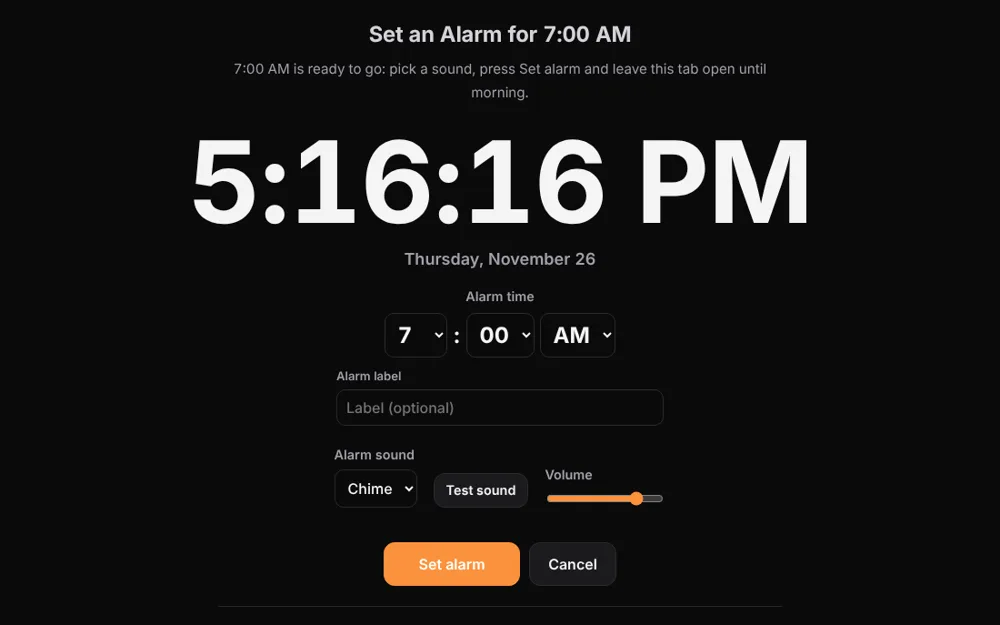
- Check the time. The pickers read 7:00 AM; nudge the minute if you want 6:45 or 7:10.
- Add a label. A short message such as "School run" appears on screen when it rings.
- Choose the sound. Pick Beep, Chime, Digital, Soft or Bell, set the volume and press Test sound; that test sound is also the click the browser needs before it will play audio.
- Press Set alarm. The status line and countdown confirm it.
Worked example: at 10:30 PM I keep 7:00 AM, label it "School run", choose Digital at about 75% volume and press Set alarm. The status line reads "Alarm set for 7:00 AM" with tomorrow's weekday in brackets, and the countdown shows Rings in 08:30:00. Had I opened the page at 7:20 AM instead, seven would already have passed, so the tool would set it for the next day.
What happens when the 7 AM alarm goes off?
When the 7 AM alarm goes off, your sound plays and repeats for up to 10 minutes, and two buttons appear: Stop alarm and Snooze 5 min. Esc stops it from the keyboard and S snoozes it.
The label you typed shows with the alarm, so "School run" or "Team call 8:30" tells a groggy brain what the morning is for. Keep the volume up before bed; the volume slider in the tool can only work inside the computer's own volume level.
Snooze gives you exactly 5 minutes, then the same sound returns. The Stop button ends the alarm completely and returns the page to the clock, ready for tonight's alarm. Before it rings, the time left is visible in the status line, and the browser tab title shows the alarm time with a clock icon.
What time should you go to bed to wake up at 7 AM?
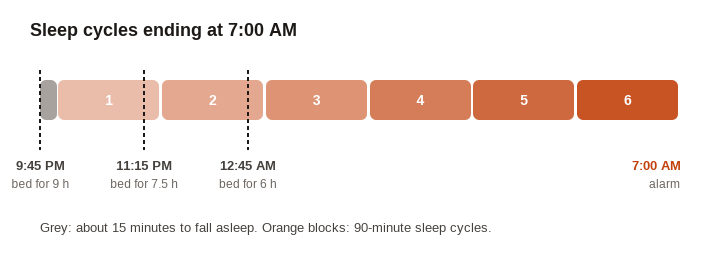
To wake up at 7 AM, go to bed at about 9:45 PM, 11:15 PM or 12:45 AM; those bedtimes fit 6, 5 or 4 full sleep cycles of roughly 90 minutes, plus about 15 minutes to fall asleep. They are the same three times the planner under the tool shows for a seven o'clock alarm.
| Cycles | Sleep time | Bedtime for 7:00 AM |
|---|---|---|
| 6 | 9 hours | 9:45 PM |
| 5 | 7.5 hours | 11:15 PM |
| 4 | 6 hours | 12:45 AM |
Cycle length varies from person to person, and 12:45 AM gives only about 6 hours of sleep, below the 7 to 9 hours suggested for adults, even though it lands on a cycle boundary. For a seven o'clock schedule I find 11:15 PM a comfortable fit for adults with evenings, and 9:45 PM the better one for school-age kids.
The bedtimes are starting points for planning, not medical advice.
How many hours of sleep does each bedtime leave before 7 AM?
Each bedtime before a 7 AM alarm leaves the hours until seven minus about 15 minutes to fall asleep, so a 10:00 PM bedtime gives roughly 8 hours 45 minutes. That simple sum is worth doing on nights when you can't hit a neat cycle boundary.
A full night for most people means going to bed by about 11:00 PM. Going to bed at 9:00 PM gives about 9 hours 45 minutes, 11:00 PM about 7 hours 45 minutes, 11:30 PM about 7 hours 15 minutes, midnight about 6 hours 45 minutes and 1:00 AM only 5 hours 45 minutes. Counting in 90-minutes cycles is tidy, but the clock sum is what decides how much rest you get.
The National Institute of Neurological Disorders and Stroke puts most adults at 7 to 9 hours a night, so any bedtime later than about 11:45 PM puts a 7 AM riser below that range. 9 hours is the generous end, not a requirement.
A 2:15 AM bedtime fits only three cycles, 4.5 hours, which is emergency only territory and well below the recommended range.
Why is 7 AM such an easy alarm to snooze?
7 AM is easy to snooze because it feels like there is slack: the day doesn't start until 8 or 9, so a 7:00 alarm invites "just five more minutes". That negotiation is how a hard morning begins, with a rushed breakfast and a missed bus.
The fix is to decide in advance what the alarm means. If you want a different hour, set alarm for 6 am and set alarm for 8 am show the bedtimes for those wake-ups. If 7:00 is the time you must be standing up, treat Snooze as off-limits; if you like a gentle start, set 6:50 and allow exactly two snoozes. Either way the chosen sound should be one you can't sleep through, and I've found Bell or Digital easier to notice than Soft.
Waking up groggy is normal for a few minutes, and a computer across the room makes you stand up to stop it. If you feel exhausted every morning despite enough hours in bed, that is worth raising with a doctor rather than solving with more alarms. A steady commute time also helps, because the alarm then has a fixed reason behind it.
How do you stop sleeping through a 7 AM school-day alarm?
You stop sleeping through a 7 AM school-day alarm by making the alarm loud enough, hard to dismiss from bed, and the same on every school night. Most missed seven o'clock alarms come from a muted laptop or a half-awake press of Stop.
- Set it after homework, not at bedtime. Open the page once the evening's screen work is done, so the tab is ready and the sound is tested.
- Place the computer away from the bed. With the screen on or dimmed, walking over to stop it is half the job of waking up.
- Repeat it Monday to Friday. Set it every school night so a morning routine or gym session time never drifts.
Teenagers generally need 8 to 10 hours, so a 7 AM school alarm points to a bedtime near 9:45 PM. Snoozing at that early hour is tempting, so decide beforehand how many snoozes you allow. It also helps to lay out clothes and lunch the night before so the first ten minutes after the alarm need no decisions.
On a shared device, a clear label like "Leave at 7:40" helps everyone. The tool holds one alarm at a time, so setting it each evening doubles as a check.
Does the 7 AM alarm follow your own time zone?
Yes, the 7 AM alarm follows your device's own time zone, so it rings at 7:00 AM local time wherever your computer thinks it is. The tool has no city or zone picker, which keeps the setup to a single click.
That matters after travel. If you land in a new place and your laptop still shows home time, the alarm will ring at seven home time; turn on automatic time zone in your device settings and reload the page before you set it. The preselected 7:00 always means local time, and the remaining time in the countdown is measured on the same clock.
Daylight saving changes are handled by the device clock, so an alarm set the night daylight saving time starts or ends still rings at 7:00 on the new time.
On mobile browsers the same rule applies: the phone's clock is the reference, and the time shown at the top of the tool is the one the alarm uses.
How does the 7 AM alarm keep accurate time?
The 7 AM alarm keeps accurate time by comparing the alarm moment with your device clock as it runs, so it rings when the computer's clock reaches 7:00:00 and is exactly as accurate as that clock.
The page needs to stay open, but it doesn't need to be the front tab; browsers still run it in the background on a desktop. For a wake-up alarm only your own clock matters, and the world clock shows what seven o'clock is in other cities.
The bedtimes follow a fixed method: count back 6, 5 and 4 cycles of 90 minutes (9, 7.5 and 6 hours) from the alarm and add about 15 minutes to fall asleep. Change the alarm time and the planner recalculates.
Need a different tool? Browse all alarm clocks.
Bedtime suggestions are general guidance based on average 90-minute sleep cycles, not medical advice. Talk to a doctor about ongoing sleep problems.
Frequently asked questions
What is 7 AM in 24-hour time?
7 AM in 24-hour time is 07:00. Devices that use the 24-hour format show the alarm as 07:00 without AM or PM, and it rings at the same moment either way. The matching bedtimes read 21:45, 23:15 and 00:45.
Can I set the alarm tonight for 7 AM tomorrow?
Yes, you can set the alarm tonight for 7 AM tomorrow; once seven has already passed today, the tool automatically schedules the next morning. The status line shows the weekday so you can double-check. Leave the computer awake and the tab open overnight.
Can I set 6:45 or 7:30 instead of 7:00?
Yes, change the minute picker before pressing Set alarm and the page sets 6:45, 7:30 or any other time. The sleep planner follows the new time: 6:45 AM gives bedtimes of 9:30 PM, 11:00 PM and 12:30 AM, while 7:30 AM gives 10:15 PM, 11:45 PM and 1:15 AM.
Does closing the tab stop the 7 AM alarm?
Yes, the 7 AM alarm stops if you close the tab, because the page does the timing. You can use other tabs and apps or minimize the window; the alarm still rings while its tab is open, whereas closing it would cancel the alarm. It's safest to keep the page visible and the computer awake all night.
How long is the snooze on the 7 AM alarm?
The snooze lasts 5 minutes, and then the alarm rings again with the same label and sound. Some alarm sites use 9 minutes; five keeps a 7:00 alarm from becoming 7:30 after a few presses. Press Snooze 5 min or the S key.
Can I change the sound for the 7 AM alarm?
Yes, choose any of the five sounds before you press Set alarm, and use Test sound to preview it. The volume slider sits beside the sound choice, and your pick is remembered next time. In my experience a sharper tone like Digital cuts through a closed door better than Soft.
Are my alarm settings saved?
Your sound and volume settings are saved in browser storage, and nothing is uploaded. They come back when the page is reopened, but the alarm only rings in an open tab. The tool holds one alarm at a time, so set one alarm and back it up on your phone.
Will this alarm really wake me at 7 AM?
The alarm will wake you at 7 AM if the tab stays open, the computer stays awake and the sound is loud enough to hear from bed. The sound plays at the volume you set from the first second. On a phone, keep it charged and stop the screen locking, because a sleeping phone pauses the page.
Is this a 7 AM alarm or a timer?
This page is an alarm, which rings at a clock time, 7:00 AM, rather than a timer, which counts down a length of time. If you want a fixed countdown such as 20 minutes, the online timer is the right tool; the countdown here simply shows the time left until seven.
Is a browser alarm enough for school and work mornings?
A browser alarm is enough for naps, reminders and mornings when the computer stays on, but it is risky as your only main alarm before school or work. Laptop speakers are small and Stop is one click, so add a second alarm on your phone for anything you can't miss.
Does the alarm work if my computer is muted or goes to sleep?
No, a muted computer shows the alarm on screen with no sound, and a sleeping computer doesn't run the page at all. Unmute it, set power options so the screen and system never sleep while plugged in, and test the sound before bed. The page needs the internet only to load; after that it relies on your device clock, which reads the system time.
The on-screen buttons are only a visual cue, so treat sound as essential. A muted laptop with a perfectly set alarm still lets you oversleep. For people who sleep heavily, a loud tone, a pop-up they can't miss, and a computer placed across the room make the 7 AM alarm hard to ignore.