How long do you boil eggs with an egg timer?
With the cold-water method, cover large eggs with cold water, bring them to a rolling boil, take the pot off the heat, cover it and start the egg timer: about 3–4 minutes gives a runny soft yolk, about 5 minutes a firmer white with a runny center, 7–8 minutes a jammy yolk and 10–12 minutes a fully set hard-boiled egg. Those standing times come from Egg Farmers of Canada, and altitude and egg size shift them.
On this page
Every time in this guide is a range, not a promise. A small egg straight from a warm counter cooks faster than an extra-large one from the back of the fridge, and a pot at 7,000 feet behaves differently from one at sea level. I start at the low end of each range and taste-test one egg before committing a whole batch.
For breakfast, the soft end of the scale suits dipping toast or toast soldiers; the firm end suits salads and sandwiches. The timer does the remembering, which is the only hard part. Once the cold water has come to the boil, the work is all in the waiting.
How to use the egg timer
The egg timer has four one-tap doneness presets, so you can start it with wet hands in a busy kitchen: Soft (4 minutes), Medium (5), Jammy (7) and Hard (11). It is free and runs in your browser with no signup. Tap a preset and the countdown begins at once.
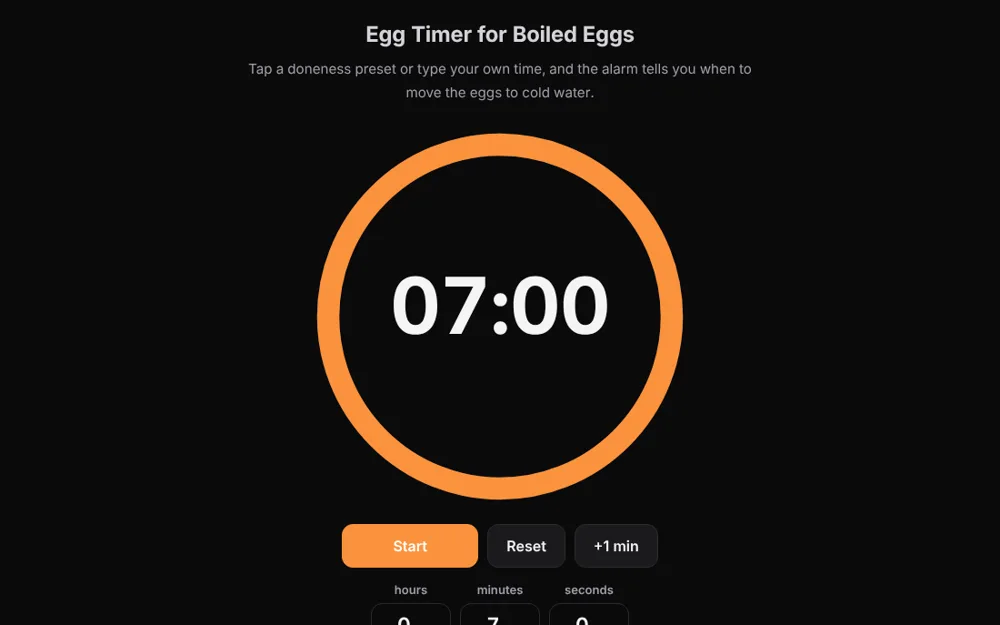
- Boil: put the eggs in a pot, cover with cold water and bring to a rolling boil.
- Off heat: take the pot off the burner, put the lid on, then click start on a preset or type your own time.
- Cool: when the alarm rings, the eggs are ready; move them to cold water straight away.
Each preset sits inside the standing-time range in the table below, and you can type any other time in hours, minutes and seconds. Adjust for egg size yourself: a little less for small eggs and a little more for extra-large.
Worked example: the Jammy preset (0 h 7 min 0 s), sound Bell, volume high. Result: the progress ring empties at 0:00, the "Time's up!" banner appears with Stop alarm and Restart, and the bell keeps ringing for up to 60 seconds until you press Stop alarm or Esc, which is plenty of time to drain the pot.
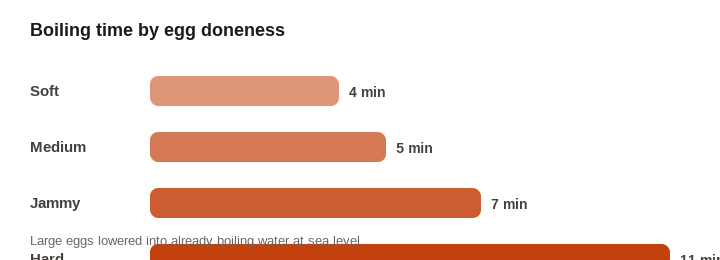
How long does each egg doneness take?
Each egg doneness takes a different standing time once the pot comes off the heat, from 3 minutes for the softest yolk to 12 minutes for a fully cooked one. The table below uses large eggs and the Egg Farmers of Canada off-heat method, with the matching timer preset in brackets.
| Doneness | Standing time (large eggs) | Yolk texture | Good for |
|---|---|---|---|
| Soft (preset 4 min) | 3–4 minutes | Runny, set white | Toast, ramen |
| Medium (preset 5 min) | about 5 minutes | Runny center, firmer white | Breakfast bowls |
| Jammy (preset 7 min) | 7–8 minutes | Thick and spreadable | Grain bowls |
| Hard (preset 11 min) | 10–12 minutes | Fully set | Salads, deviled eggs |
The yolk texture changes fastest in the middle of the range. The step from 5 to 7 minutes is where a yolk goes from liquid to jam, so a single minute matters more there than at the hard end. Past 12 minutes you mostly gain a grey ring and a rubbery texture, not a better egg. Soft and jammy yolks are not fully set, so if you are cooking for someone who needs fully cooked eggs, choose the Hard preset and follow your local food-safety guidance.
These times do not cover poached eggs, which cook outside the shell in barely simmering water. They also assume sea level: above 3,000 feet you need an altitude adjustment, covered below.
What tips give better boiled eggs?
The most useful tip for better boiled eggs is to move them into ice water as soon as the timer rings, because rapid cooling stops the yolk cooking and helps prevent a green ring. Leaving eggs in the hot pot "for a minute" is how a jammy yolk turns hard.
Peeling is the second battle. The less fresh the egg, the easier it is to peel, so for deviled eggs or egg salad it helps to boil eggs that have been in the fridge for a while. Hard-boiled eggs in their shells keep for a week in the fridge in a sealed container, which makes them handy for meal prep and a quick protein snack.
This guide uses the cold-water, off-heat method; recipes that keep eggs simmering use different times, so do not mix the two. Whichever you use, stop the cooking in cold water for a few minutes once the alarm rings.
How hot should the stove be for boiling eggs?
The stove should be on high only until the water reaches a rolling boil, and then the pot comes off the heat entirely for the cold-water method. Heat after that point does nothing useful; the hot water finishes the eggs on its own, which gives even cooking and less cracking.
Starting the eggs in cold water means they warm up with the pot rather than being dropped into fierce heat. Eggs straight from the fridge can take a little longer than the table suggests, so test one before committing the batch, and handle them gently when placing them in the pot.
Water also boils at a lower temperature as you go higher, so the same stove setting gives cooler water in the mountains. That is the one case where turning the heat up does not help, because boiling water cannot get hotter than its boiling point.
Whatever the stove setting, only cold water will stop the cooking once the alarm rings.
Does altitude change egg boiling time?
Yes, altitude changes egg boiling time, because water boils at a lower temperature the higher you are, and eggs in cooler water need longer. According to the USDA Food Safety and Inspection Service, water boils at 212 °F at sea level, 208 °F at 2,000 feet and about 198 °F at 7,500 feet.
The USDA notes that above 3,000 feet, food preparation may need changes in time, and that eggs cooked in boiling water take longer at high altitude. Its advice is to increase the cooking time, not the heat. Add a little time to each range and test one egg first, since the right extra time depends on exactly how high you are.
Cutting one egg open tells you more than any chart. If the white is still loose, the next batch needs a little longer in the pot. For jammy eggs the target is a creamy center inside a set white, wherever you live. Use the minutes and seconds fields to fine-tune rather than relying on the presets alone.
How does the egg timer tell you the eggs are ready?
The egg timer tells you the eggs are ready with a sound alert, a "Time's up!" banner and an optional desktop notification. You pick the sound (Beep, Chime, Digital, Soft or Bell), set the volume, and press Test sound once before you start cooking.
While the eggs stand, a circular progress ring drains around the digits, and the remaining time is shown in the browser tab title. The ring reads clearly from across the stove.
Keep the browser tab open until the alarm rings and check that your device is not muted. Some browsers block sound until you click on the page once, so tap anywhere before you start: the audio only plays if your device is not silenced. If you use headphones, unplug them first, or the alarm plays where nobody can hear it.
How does the egg timer keep accurate time?
The egg timer stays on time because pressing Start records the finish moment, and the page checks it against your device clock four times a second. That means the countdown cannot drift, even on a slow laptop.
This matters when you switch apps to read a recipe. Browsers slow down hidden tabs, but the end check keeps running, so the alarm still rings on time. The timer reads the device clock directly rather than counting ticks.
For the egg itself, the bigger error is usually in the method, not the clock. Starting the timer late, before the water truly boils, or forgetting the ice bath changes the result far more than a fraction of a second. Treat the presets as approximate cook times and adjust from there. For the other steps in the kitchen, such as resting rice or steeping tea, the 5 minute timer and the 10 minute timer start with one click.
Need a different tool? Browse all timers & stopwatch.
Cooking times are guidelines. For food safety, cook eggs until whites and yolks are firm if you are pregnant, elderly, very young or have a weakened immune system.
Frequently asked questions
Do I start the egg timer before or after the water boils?
Start the egg timer after the water reaches a rolling boil and you have taken the pot off the heat. Put the eggs in cold water, heat on high until it boils, then take the pot off the heat and cover it. That is the method the presets and the table assume. Recipes that keep the eggs simmering use different times, so check the recipe if you follow one.
Is the egg timer free?
Yes, the egg timer is completely free, with no account and nothing to install. All preset buttons and the custom time fields are available to everyone. The page runs in your browser, and it works the same on a laptop, a tablet or a phone.
Does the egg timer work on mobile?
Yes, the egg timer works on mobile in a modern browser such as Chrome, Firefox, Safari or Edge. The page asks your phone to keep the screen awake while it runs, where the browser supports it. Some mobile browsers pause pages when the screen locks, so keep the screen on while the eggs stand.
Will I hear the alarm when the eggs are done?
Yes, you will hear the alarm if your device is not muted and the volume slider is up. The sound rings for up to 60 seconds with the banner on screen. You get the sound you chose, and you can switch to another of the five sounds before the next batch.
Can I pause the egg timer?
Yes, you can pause the egg timer with Pause or the spacebar, then press Resume to continue. Press R to reset, and Esc stops a ringing alarm. Need more time? Press + or the +1 min button. Pausing is rarely useful mid-boil, because the eggs keep cooking in hot water either way.
Does the egg timer work offline?
The egg timer needs an internet connection only for the first page load; the countdown itself runs in your browser and sends nothing to a server. Once loaded, it keeps running in another tab and the alarm still rings. On a mobile connection that drops in the kitchen, the timer carries on.
Can I use the egg timer as a general kitchen timer?
Yes, the egg timer works as a general kitchen timer for anything you can time in hours, minutes and seconds. I use it for ramen noodles, rice for rice bowls and grains for grain salads, adjusting the time with the +1 min button. For eggs at altitude, add a little time and test one first.
Which browsers does the egg timer support?
The egg timer supports any current browser, including Chrome, Firefox, Safari and Edge, on desktop and mobile. After the initial page load, it does not need the internet to count down, so it is effectively offline-capable while the tab stays open. Older browsers may not support the screen wake lock, but the timer still works.
Is my data tracked by the egg timer?
No, your data is not tracked: there is no login, and no personal data is collected or sent to a server. Your sound and volume choices are saved only in your own browser. A running countdown is not restored if you reload or close the tab, and nothing about your cooking leaves the page. For boiling times, the table above follows Egg Farmers of Canada guidance.